Tuesday, October 26, 2010

The Giver

    The Giver  is written by Lois Lowry and is geared toward 5th-6th graders.  I rate this book 5 out of 5 stars. 
    This book depicts a society where everything is the same, where everyone follows the rules, and where everyone has no control over their lives or choices.  There are no colors, emotions, or freedoms.  Yet, everyone seems satisfied with the society in which they belong.  Jonas, a 12-year-old boy, has been selected to be the new Receiver for the community.  At first, he is completely startled and overwhelmed at the “award” and doesn’t know how he will benefit his community members.  Once he begins his sharing sessions with the Giver, he is given the memories that the rest of his community does not have.  Memories of pain, war, snow, and other joyous and hideous things fill his mind and a weight of knowing weighs Jonas down.  It affects how he relates to his family and friends.  He is not himself anymore and he cannot believe that no one else in the community lives their lives without this knowing too. 
Jonas and the Giver divulge a plan for Jonas to escape the community and go Elsewhere.  He takes with him Gabe, a young toddler that Jonas’ father brought home from the Nurturing Center.  Jonas chose to bring Gabe because Gabe was going to be “released”, which Jones soon found out meant killed.  He saved Gabe’s life and swept a plethora of memories across the community when he left since the memories are released if the Receiver no longer retains them.  The book concludes with Jonas sitting atop a hill on a sled, Gabe on his back, much like the first memory that was passed to him from the Giver.  He slides down the hill toward light and it is difficult to distinguish toward the notion of Jonas dying from the cold and hunger that consume him or finally reaching peace and serenity in a life he has chosen for himself. 
    This book is amazing for classrooms.  I remember reading it in 6th grade and I cannot remember how I understood all of the information in the book.  Maybe I just didn’t get some of the major points.  It is incredible that this is considered a children’s book because I found some of the topic discussed mystifying and I cannot imagine what a younger student might think.  So many themes are discussed thoroughly in The Giver, like power, choice, freedom, pain, sacrifice, memories, and diversity (or lack thereof).  The elders in the community hold all the power: in the rules, the assignments that determine what people do for careers, the joys people are allowed to have.  This infringes on the choices and freedom people take for granted, even until this day and in this country.  There are places in the world where people cannot choose their actions, whom they marry, their religion, or what they say.  The people of North Korea are only exposed to the media and information that the government seems fit- this is the society in The Giver that still exists today. 
    Jonas is chosen to be the only one to experience pain in the community and so he carries the burden alone.  He can’t communicate the details of his work, so no one can even empathize with him.  He is a young child who is overwhelmed with all these new feelings, sights, sounds, and ideas with no one there for him.  He has to sacrifice his whole life- everything he has and everything he is turns into him being the Receiver.  He doesn’t get to have relationships that he did before because 90% of his life is now hidden.  The community is so homogeneous; there is no distinction between people besides the name that they are given.  They live with cookie-cutter families in houses that are the same.  They have the same routines with the same sharing of feelings, and they all follow the same paths in life.  They know nothing of the people who came before them.  Everyone in the community thinks their ancestors lived the same lives they currently live.  However, Jonas learns that people had memory at one point in their lives.  Their lives were not the same at all, they had diversity and color and fear and pain, which is something that is completely absent in his currently society.  Only Jonas knows that the society they live in is not what anyone thinks it is.  It is not how it always has been; it is some life sucked dry of anything too good and anything too horrible. 
An illustration representing the first time Jonas saw color
The Giver is a book that can inspire a lot of different discussions in a classroom that can follow a lot of paths.  Students can feel grateful about the societal choices and freedoms they have and can realize that there are other people who are not as fortunate.  Students can find things in the book they identify with and things they can never see themselves being familiar with.  They may feel bad for Jonas and wonder why he doesn’t rebel against the Elders to their faces.  No matter what students you have, they will have questions.  They will be passionate in their discussions because they will be shocked at how different this society is from the one they have become so accustomed to. 

Here is a 15-day unit lesson plan on The Giver!

Madeline and the Cats of Rome

    Madeline and the Cats of Rome is written and illustrated by John Bemelmans Marciano.  This book is for children in grades 1st-3rd.  I would rate this story 5 out of 5 stars (but I LOVE Madeline!). 
    This book is about a time when the girls and Miss Clavel set out from Paris to go to Rome when the sky is gloomy.  When Miss Clavel is trying to take a picture of the twelve little girls, a thief comes and snatches her camera and sprints away.  Madeline, deciding to be a hero, runs after the girl, but lost her in the end.  Suddenly, a cat is rubbing against her leg and of course Genevieve (the dog) does not appreciate this feline invasion, so she chases her off.  Madeline follows Genevieve into an abandoned house where Madeline discovers several cats living there.  The thief appears out of the dark and states that she is steals just to help the cats.  After Madeline pulls the guilt card, the thief returns the camera.  Madeline and the thief later end up in jail and Madeline finds out the thief is no orphan and has a family who is looking for her.  Once the story is explained, the two girls work together to adopt the cats out to the travelers in Rome.  Every cat goes to a great home!


    This book emphasizes so many various lessons and tidbits of information.  Initially, the author introduces the sights of Rome, including the Sistine Chapel and includes images of the Parthenon and other sights.  These images are hardly shown in children’s picture books, so any opportunities to immerse students in these sights are great.  Also, when Madeline confronts the thief, she says, “While I applaud your charity, Let me say this with clarity: STEALING IS WRONG- no matter the cause.  You may not like it, but those are the laws.”  This lesson is so important to stress to children at an early age and in a context that they can understand what stealing is.  This also shows that stealing doesn’t have to happen in a store or just be money to be wrong.  Stealing happens all the time, everywhere, to all different types of people and students shouldn’t be shielded form this fact, so that is a great point made. 


    Also, when the girls are all trying to adopt the cats out, the idea of charity is stressed.  They didn’t have to go back to help the cats, but insisted on providing them with good homes to live in.  They took it upon themselves to be good Samaritans and this is a lesson students should learn.  It could inspire them to volunteer or give up things they no longer need for less fortunate people.  While the girls are adopting the cats out, there is also a sign in three different languages, which shows that they are in a foreign place and it juxtaposes the words “CATS TO ADOPT” in English, French, and Italian.  This introduces (though very slightly) some foreign language, which young children cannot have too much of.  On the page next to it, there are people taking the cats home from all over the world, with typical dress and appearance for those countries, which is also a good thing for children to take note of.  There is so much to get out of this book that is cultural and it is humorous at the same time.

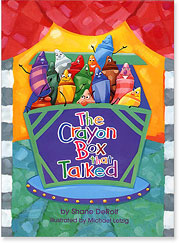
The Crayon Box That Talked

    The Crayon Box that Talked is written by Shane DeRolf and illustrated by Michael Letzig.  It is geared toward preschool or kindergarten students and I would rate it 4 out of 5 stars.
    This book is about a young girl who goes to a toy store to find a box of crayons that are all up in arms with each other.  They don’t like one another, with no reasons given for the animosity.  The girl purchases the crayons and when she gets home, she begins to draw a picture with all the colors, showing that they are all needed to complete a beautiful picture.  The crayons also learn that they have to work together in order for art to be created and they can blend together to create new colors of beautiful things.  In the end, the crayons are getting along and embrace each other since everyone is needed. 
    Using this book in an elementary classroom, especially the younger grades, will be a simple way to teach diversity without connecting the idea to people yet.  Since it is the crayons (which all happen to be different colors, like people) that are fighting, it is somewhat unlikely that students will immediately think that the book is metaphorical.  Students will learn that everyone needs to work together to get everything needed done.  Also, it is a great way to introduce the idea of mixing colors together to get a new one.  Since the crayons blend and color over one another to form new shades, students can try this on their own to experience the act. 
    Since the book is also written in rhyme, it will especially appeal to the younger children by keeping their attention in tune with the rhythm of the story.  A lesson involving this book could consist of students getting a pile of crayons and having to use every color coherently to create a picture.  If students can see how well the colors work together and benefit the picture, they might make the connection on their own about how each person is important to a community.  This book could be used to introduce diversity or the components of a group of people. 
There is a whole mini-unit that can be used based on this book.

The Colors of Us

The Colors of Us is written and illustrated by Karen Katz.  It is geared toward kindergarten to 1st graders.  I would rate this book 3.5 out of 5 stars.
    The book begins with a young girl painting a self-portrait.  Her mother (an artist) informs her that if she mixes red, black, yellow, and white together just right, she will be able to find a color that matches her skin just right.  The little girl replies by saying that brown is brown.  The mother then takes the girl on a walk to show her all the different shades of skin that exist in the people they know, often relating their skin color to a food of some sort.  At the end of the story, the little girl is amazed at how different all the portraits turned out of all her friends and family.  She learned that there are many different skin colors, but they all have the same basic colors used.
    This book is great for introducing diversity to a younger classroom of students to the idea of diversity.  Even if students have already noticed that different skin colors exist, they could realize that they have the basic colors to start with.  A classroom of students could even experiment with skin tones in paint and other art mediums.  The illustrations are also really fun, so students won’t think they are reading a book that is a structured lesson at all.  Many students, especially in a diverse classroom, will notice that many of their classmates or friends have different skin tones and this should be embraced and celebrated instead of swept under the rug.  Books like this can help bring out the diversity and realize that it is quite amazing how communities are composed of such different people. 


Here is a The Colors of Us lesson plan by Karen Katz!

It's Okay to Be Different

The book It’s Okay to Be Different is written and illustrated by Todd Parr.  It is geared toward preschool to kindergarten students.  I would rate this book 4 out of 5 stars. 
    The premise of this book is simple: diversity is okay and is seen everywhere someone looks.  Some examples of the different things that are shown include: having missing teeth, being bald, having wheels (like a wheelchair), and being adopted.  Each page displays a different person with different aspects of their lives that people may find peculiar. 
    This book is great for introducing the idea of diversity to children, especially at an age where children don’t really see the skin color differences.  However, children painstakingly notice differences like a wheelchair and will blurt out comments that can embarrass everyone around.  The illustrations are very colorful, so they do not depict one particular group of people and sometimes use animals to show the differences.  The book also links very silly things (like eating macaroni in the bath tub) to very serious things (like it’s okay to have different moms). 
Students may be more at ease with a serious topic if there are things that they can laugh at thrown into the mix.  This lifts some of the burden from the teacher and translates the word diversity into words that children can understand and relate to.  Children will also be able to point out people in their own lives that they see represented in the book and realize that they have already accepted the terms of diversity without consciously doing it. 

Locomotion

Jacqueline Woodson’s Locomotion is written for students in grades 4th-6th.  I would rate this book 5 out of 5 stars.

            Locomotion tells a story of a young boy named Lonnie Collins Motion (nicknamed Locomotion) through a poetry notebook he wrote for class.  His parents died in a fire while he and his sister were away on a trip to the zoo and he discusses the loss of them frequently in the book.  Since being put in a foster home with Miss Edna, Locomotion has found a comfortable place to belong.  His younger sister, Lili, lives in a more upper-class home with a mother who judges Lonnie constantly.  During the story, Lili prompts Lonnie to “find God” and gives him her copy of the Bible.  He wants to find God to get closer to Lili, but ends up finding God all around his life through the simple pleasures he enjoys.  The book mainly discusses his struggle with accepting his place of belonging and finding faith in his life.  Lonnie has experienced some horrible things, but does not broadcast it to his peers at school, which makes this book of poetry a great outlet for him.

            This book is a fabulous find to incorporate into any classroom.  It has so many unique themes that are covered and although it is not the easiest to relate personally to, the feelings Lonnie expresses are common to all people.  The theme of belonging surfaces a lot in Locomotion.  Even in the beginning of the book (p. 5-6), Lonnie recalls a memory where his mother refers to his younger sister as “her baby”.  Lonnie asks her if he was ever her baby and she tells him that he still is.  This sense of belonging to his mother sets up his future quest for the same comfort.  Then on page 33, he has a poem titled “List Poem” in which he lists everything he owns (which amounts to some clothing and parts of his body).  He writes these things out to give himself solace in the idea that he has things that belong to him in this world where nothing seems good.  On page 83, he says “Rodney’s voice sounds like it should always been in this house.” This is significant because this is Miss Edna’s older son who views Lonnie as a younger brother.  Having him move back into Miss Edna’s house means a lot to Lonnie and brings happiness to him and Miss Edna.  The voice of Rodney belongs in the house according to Lonnie, as if it is something that fits into the scene like a puzzle piece that he has been missing for years.  He needs this small detail to feel completely right in his life.  Lonnie’s teacher, Ms. Marcus, told Lonnie he had a poet’s heart (p. 87).  He goes on to say, “That’s good.  A good thing to have.  And I’m the one who has it.” This accomplishment, in Lonnie’s eyes, has brought him happiness as well as something to contribute to the world.  He was searching for a way to be good at something and since he found he had this heart inside him, he felt a wave of happiness wash over him. 

Jacqueline Woodson

            Locomotion is a book that can be taken in many different ways.  It is simple in language and writing style, but if you peel back the words to discover the character’s motivation and emotion, it is not hard to see that this book can be the source of great discussions in the classroom.  Students can open up about many things that are discussed in the book: adoption/foster care, having a friend who is sick, growing up in a low-income area, the loss of one’s parents at a young age, having your first crush, and many other interesting dynamics that are presented.  Teachers can really dig deep and make the book connect to their students, no matter what identity they hold. 

Here is a website to hear and see Jacqueline Woodson discuss her books: http://www.teachingbooks.net/spec_athr.cgi?pid=3460&a=1 and here are some teaching guides to accompany her books!

Scholastic also has this great discussion guide for Locomotion.  There is also an extension activity.


Monday, October 25, 2010

The Man Who Walked Between the Two Towers

            The Man Who Walked Between the Towers is written and illustrated by Mordicai Gerstein.  It is written mainly for 3-4 grade students and I rate this book 4 out of 5 stars. 
            This book tells the story about Philippe Petit who strung a wire between the two towers of the World Trade Center and walked across in a daring act (See video of it HERE) .  He had previously walked between the two steeples of Notre Dame in Paris, where he was from.  Since the idea of him doing this seemed too dangerous to the owners of the towers and the police, he had to secretly plan to get the wire up and walk across.  Since the buildings were in the end stages of being built, he dressed as a construction worker and snuck in.  As he walked the wire when day broke, he was spotted and everyone began to gather around the towers to see.  Immediately, there were several policemen on the roofs of both towers, demanding that he come to the end of the wire to be arrested.  He danced around on the wire and even lay down.  When he went before a judge after being arrested, the judge ordered that he perform in the park for children.  The last two pages of the book are somewhat ominous.  After describing his act in the park, the next page shows the New York City skyline without the towers (presumably after 9/11) and the last page reads “But in memory, as if imprinted on the sky, the towers are still there.  A part of that memory is the joyful morning, August 7, 1974, when Philippe Petit walked between them in the air.”

            Since this book is geared toward elementary students, it is pretty acceptable that the author just glazed over the whole day of 9/11 to not distract the reader from the story at hand.  However, just simply stating “Now the towers are gone” can lead some students to be confused and wanting to know more.  The author could mention September 11, 2001 without going into too much detail.  Readers need something to go off of, especially students currently in elementary school who were babies in 2001. 

Images of Philippe Petit walking from tower to tower

            The illustrations of Philippe stringing up the wire at night are so great because they remind the reader that the act is taking place under the cover of darkness but still allows them to see everything that is going on.  Gerstein does a great job making the city glow beneath them and keeping the foreground dim.  Also the way in which the illustrations appear on each page is different: some pages have three long, panoramic illustrations (representing the sunrise as he gets ready to walk the wire), some take up the whole page, and some have two on one page with text dividing them in the middle.  It allows the reader to constantly be surprised by what they are seeing next. 
            Obviously this is a story that is not told very often, so any opportunity to explain a true event like this to children through a picture book is awesome.  The way in which the author juxtaposes the loss of the towers and the image of hope and happiness in Philippe in the last two pages is a great way for children to consider the literary elements.  They can consider something that is sad that happened in their lives and compare it with something better, but still related.  The teacher can also select random acts in history like this one that are free of political or cultural ties for students to discuss.  Since it is just so extraordinary, students may have a great time exploring other events like this one in the classroom through a reading and writing activity.   The rhythm used in this story can also be discussed in depth.  It is not quite a rhyme on every page, but the author does incorporate some sort of pattern in writing style, so students can develop their own writing style and form when writing of another event in history. 


Here is a lesson plan for this book that analyzes character traits: http://www2.scholastic.com/browse/collateral.jsp?id=32439