Monday, October 11, 2010

Zoom


            The wordless picture book Zoom is by Istvan Banyai.  It is geared toward 1st-4th graders.  I would rate this book 4 out of 5 stars. 
            This book starts with a picture that is hard to make out what it is.  As the reader moves to each page, the image zooms out more and more.  The reader is constantly shocked that the world they perceived to be to scale is actually much tinier than imagined.  A farm becomes a toy set which becomes the cover of a magazine which becomes a cruise ship which becomes an ad on a bus on a television in the desert which is a stamp on a letter on an island that a plane is flying over.  Then the pictures zoom out  to the Earth form space. 


Page 2 in Zoom
Page 1 in Zoom


  Zoom could be used for students to think about what communities they are in on a small and large scale.  For instance, a child could draw themselves on a soccer field playing with their team then draw their school as a whole, then draw their city as a whole, their state as a whole, their country as a whole, and so on.  This can help students assess how many levels play into their lives.  Students could also explore the idea of this book using photography or drawing.  


A Sequence in Zoom
They could find an object in nature or in a classroom, say a flower.  They could begin really close to it and back up until the observer can tell what the object is.  This is a way for students to feel like they are inventing riddles, so the interest level will be high.  

The Higher Power of Lucky


            The novel The Higher Power of Lucky is written by Susan Patron and is geared toward 4th through 6th graders.  I would rate this book 4.5 out of 5 stars. 
            The Higher Power of Lucky tells the story of a ten-year-old girl named Lucky who is growing up in a trailer in Hard Pan, California, population 43.  She is a young girl very interested in science and closely studies the community around her.  She became inspired to find her higher power, or spiritual strength, while eavesdropping on 12-step program meetings about people who have hit their rock bottoms.  She lives with her father’s ex-girlfriend Brigitte, after her mother died in an accident after a storm took down a power line.  She is a driven little girl who is always prepared for the worst with her survival pack and hope for the best with her best friend Lincoln in tow. 
            This book would be a good example of how to use setting to enhance a story.  Lucky is surrounded by basically nothing- a town in the middle of the dessert with a population of less than 50.  Yet she still finds countless things to explore and many details to attend to.  Students could find ways to see their community or setting in new ways to write about in class after reading The Higher Power of Lucky.  The narration of the novel is also a great reference for students learning how to write stories.  Narratives can be a daunting task for new writers, but the way that readers get to be inside Lucky’s head as she examines her world is a great opportunity to see the literary element of voice exercised to its fullest potential.  The voice and point of view of the story really affects the experience the reader has and deepens the connection between the reader and Lucky.  Susan Patron really does a great job at mimicking the thoughts and emotions of a ten-year-old girl, so this book should be quite relatable for most elementary students. 
            This book is a great novel to introduce a unit on writing narratives.  If students can use The Higher Power of Lucky to find their own voice, their writing will be genuinely reflective of the thought in their heads.  Students can also really relate to some ideas like feeling confused about their identity or a feeling of loneliness.  Lucky feels somewhat distant from Brigitte and the idea of a loss of a close loved one is discussed, but in a way that is not too heavy for children to get through and get to the other parts of the story.  This book is great because it touches on a lot of aspects of a person’s life: family, the search for something greater, curiosity, and friendship.  Students are bound to connect with some part of Lucky’s life, which makes this book versatile and usefully in a diverse classroom.  

Here is a link to build wind chimes in your classroom like those in the Found Object Wind Chime Museum in the book.  

The Way I Feel


            The Way I Feel is both written and illustrated by Janan Cain.  It is written for younger elementary students and for students in special education classrooms.  I would rate this book 4 out of 5 stars. 
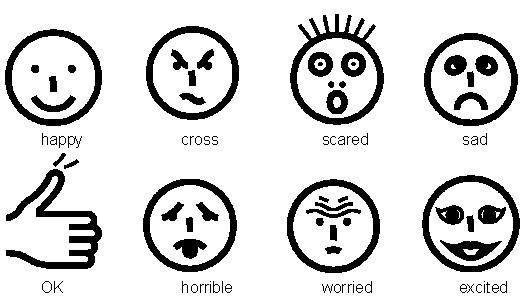
            This book displays a different emotion on each page with a description of situations that ignite that emotion and illustrate the way people look when they are feeling that way.  Some of the emotions discussed are disappointed, thankful, and jealous, among others.  Each page is also written in rhyme and the font is arranged in various ways, mostly reflecting the emotion using curvy lines or jagged edges. 
            This book would be excellent if used in a special education classroom since a lot of those children struggle when expressing how they are feeling in words.  When I observed in a special education classroom, there was an emotion wall that had different emotions with facial expressions to visually cue the students into what the emotion meant.  This was useful when students were very emotional but felt like they were unreachable by the teacher because they could not vocalize how they were feeling.  This book would be great to introduce the idea of an emotion wall and can be used to describe each emotion in some detail for reference.  

Whoever You Are


          The book Whoever You Are is written by Mem Fox and illustrated by Leslie Staub.  The book is geared toward the primary grades, between kindergarten and 3rd grade.  I would rate this book 5 out of 5 stars. 
            Whoever You Are is a book about all the things that make people different, like skin color, houses, and land, but all the things that make people the same, like love, pain, and emotions.  It bridges the gap between all the diverse lands in the world by showing children from all over smiling, in school, and living their lives.  It makes it very easy for children of a young age to discuss and understand diversity on the basic level. 
            This book would be a great addition to a unit on diversity or discussing the different subgroups that make up a community.  Teachers could use this to introduce the idea of sharing different aspects of your life with someone on the other side of the world.  It also establishes a universal understanding for the way people feel about the world they live in.  Each person has the same kind of heart inside them, and Mem Fox does a great job at explaining it in an enticing way. Teachers could especially use this book if they teach in a diverse classroom, to point out the similarities between different groups in the classroom.  This could help form deeper bonds as a classroom and create a safe place for learning and sharing.  If students feel like someone who may seem polar opposite of them can be very similar and can be a friend, it opens a lot of doors for friendships.  

Tuesday, September 28, 2010

Focus Question

In The Owl Moon, the tension of the story pulls the reader along because children and adults alike really want to see the owl and experience owling through the perspective of the child in the story.  The tension is beautifully done by the author because it seems effortless and isn't right in the reader's face, but instead invites them to follow along on their own terms.  The author also recognizes that it is difficult to resist such a unique experience as seeing an owl at night with your father, so it is not a common occurrence for most people.
The place in the story is also vitally important because it is a common place hosting a truly uncommon moment.  Anyone can find woods covered in snow that is from the midwest, so it is a setting students can create mental images as the story is read.  The mental images really enhance the literary experience in the classroom.  The place is not some made-up far-away place that readers struggle to imagine.  It is a place that exists and readers can tailor it to fit their own experiences or preferences.
The point of view also is crucial to the story because it is a young girl, who is owling with her father and who has never seen an owl.  She is so anxious to finally see an owl and the moment of finally seeing one is so climatic that the reader is happy for her.  She seems so small within the huge woods and all the massive snow.  It is a small character to mirror a small, but perfect moment in time of seeing an owl.

Caldecott Medal Winners

Owl Moon:
The book Owl Moon by Jane Yolen is illustrated by John Schoenherr and won the Caldecott Medal in 1988.  It is made for children between prekindergarten and late 2nd grade.  I would rate this book 5 stars. 
            The story in this book is about a child and a father walking through the woods during the winter in search of spotting an owl.  The father repeatedly hoots into the woods and the child follows in silence, knowing one ounce of sound could ruin the whole experience.  Since all of her older brothers have been taken to spot owls with their father, she was excited to be able to know what owls are like.  Once the owl is spotted, the magical moment is perfectly captured and the child fills with so much joy and fulfillment. 
            Since this book received a Caldecott Medal, obviously the illustrations are amazing.  They mirror the story being told perfectly and allow the reader to be dipped into the world of owl sightings.  Although the father and daughter go to the woods at night, there is a glowing light that shines on them as they walk.  The snow is so bright, the story seems to be set in daylight.  The snow and the sky are both shown as white and the text is framed on this background, which makes it look like it is during the day even more.  But if the reader pays attention, one realizes that the story has to be set at night based on the descriptions about looking with a flashlight. 
            The words in this book also paint brilliant images for a reader.  The sensory images can be used in the classroom to promote writing to allow readers to share a specific moment with the writer, even in the early elementary years.  Quotes like: “Our feet crunched over the crop snow and little gray footprints followed us.”, “I could feel the cold, as if someone’s icy hand was palm-down on my back.”, and “We watched silently with heat in our mouths, the heat of all those words we had not spoken.” really demonstrate the moments that are occurring within the text.  If a child closes his or her eyes while hearing this book read to them, the images formed will be so detailed and gorgeous from the words alone.  Then being able to see Caldecott caliber illustrations really enhances the literary experience. 
            Reading this book as a child with my mom provided a lot of wonderment and magical reading moments.  This book should be shared between parent and child and between teacher and students.  In the classroom, a lesson involving “showing not telling” through writing can be introduced to children as young as first or second grade.  Instead of just witnessing simple sentences, a teacher can see deeper writing.  Any child can benefit from experiencing this book, especially ones interested in art.  To see the intensity of illustrations can instigate some interest in linking drawings to text.  Students can write their own sensory stories, then they can illustrate them too. 


Jumanji:
            Another Caldecott Medal winner, Jumanji, was both written and illustrated by Chris Van Allsburg.  The book is very interesting and can be shared with children as early as preschool and can be told to older children, such as 6th graders for the lessons and depth of the story.  I would give this book 4.5 out of 5 stars. 
           
As a classic book turned movie, not many people have avoided having some contact with some form of Jumanji in their lives.  The book tells the story of a brother and sister who have the house to themselves when their parents go to the opera.  The children find themselves bored with the toys in their house and venture into the park to find something more entertaining to do.  Judy stumbles upon a game called “Jumanji” with a  note taped to the back warning, “Free game, fun for some but not for all.  P.S. Read instructions carefully.”  As the kids play the games, they find that each of the tiles they land on actually happens.  A lion appears on the piano, monkeys in the kitchen, and a lost tour guide in the living room.  The children also know that in order to have the house return to normal, they need to finish the game and reach the golden city of Jumanji.  After weathering the harsh tiles, the duo finally makes it to Jumanji, just in time for their parents to return from the opera.  At the end, the children state that it is very important to finish what you start and follow the directions along the way, two classic lessons every parent and teacher wants children to be aware of. 
            Jumanji can be used in the classroom to ignite more imagination in children about the worlds that can be created through writing.  Teachers can use this book to begin a lesson about writing so readers can make images from the word.  The illustrations in Jumanji really match the words of the story and provide more information for the students.  The small details are an important part of the story being told.  Also, the story is about a game, which is a topic of interest among most children.  It is also very useful to children of all ages because it is magical to younger children and can spark ideas for writing.  Also, when using this book, teachers can also tie Jumanji to a unit about jungles.  Since the kids had a jungle come to them, a teacher can bring a jungle to the classroom for the students. 
            This book provides a lot of inspiration in the realms of reading and writing.  Students could even create their own board game that they bring to life.  The book is well written and flexible, making it a great asset to teachers.  I would recommend this book to students, parents, and teachers alike since it is such a great classic. 


Tuesday, September 14, 2010

Roald Dahl

My AIP Project has led me to study Roald Dahl, an award winning author who has always been one of my favorites as a child.  Who could forget reading James and the Giant Peach or Matilda as a child?  Not to mention the amazing movies that have been created based on the books written by Roald Dahl.  I completely love every book he has written and remember the stories so vividly because they captured my imagination and made me believe that anything is possible. 
This author is such an inspiration to future teachers, authors, parents, aunts, uncles, and anyone who remotely interacts with children.  He communicates his deep love and passion for writing in every word of all 61 of his books.  Just the fact that he has written 61 books amazes me.  Then add the caliber of writing within each book- it is awesome.  When I was learning about Roald Dahl, it surprised me how tragic his life was.  He lost his father and older sister when he was just three years old.  One of his sons had brain damage after a car accident and his oldest daughter died after being exposed to the measles.  Yet his writing is still whimsical and captivating, even after all the heavy heartache he must have been feeling.  It really shocked me that he continued to write no matter what and kept producing books that grab his audience. 
Roald Dahl has left really big shoes to fill by any upcoming children’s authors because he was consistent and award-winning and passionate about every part of the writing process.  He should be used to showcase the joys of writing to students- especially those suffering from misfortunes in their own lives- to encourage more writing in elementary and middle schools.